

Table of Contents
- Why Does Your Tap Water Taste Like Metal?
- How to Test Water Hardness at Home (and Check for Metals)
- Step-by-Step: How to Flush Your Pipes and Fixtures
- Best Water Filtration Systems for Metallic Taste
- When to Call a Professional Plumber
- Health Risks: Is It Safe to Drink Water That Tastes Like Metal?
- Frequently Asked Questions
Last Updated: September 14, 2026
Why Does Your Tap Water Taste Like Metal?
To remove metallic taste from tap water, first understand where the flavor comes from. A metallic taste is never random, it signals something dissolving into your water between the treatment plant and your glass, and the fix depends on what that something is.
At Dooley’s Water, nearly two decades of diagnosing water problems across Kansas and Oklahoma show a consistent pattern: most people guess wrong about the cause before they test.
The flavor usually traces to one of four sources: dissolved iron and manganese, corrosion inside aging pipes, low pH that makes water aggressive toward metal plumbing, or mineral buildup in a rarely used fixture. Each cause needs a different solution, so guessing wastes money.
Common Causes of a Metallic Flavor
Dissolved iron is the most frequent culprit, carrying a bitter, coin-like taste even at concentrations too low to discolor water.
Corrosion and leaching come next. Older galvanized pipes and even copper plumbing break down over time, releasing metal particles into the water, worse in stagnant water that sits in the lines overnight.
Low pH accelerates that breakdown. Acidic water eats through pipe walls, which is why pH testing matters as much as metal testing.
Water hardness plays a supporting role: hard water leaves sediment and mineral content deposits inside pipes that trap and slowly release metals.
Finally, sometimes the problem is your faucet aerator, not your water supply at all. A clogged aerator collects debris that produces a metallic or bitter taste in just one fixture.
If only one faucet tastes metallic, do not assume your whole supply is contaminated. Check that fixture’s aerator before spending money on whole-home treatment. A five-minute cleaning often solves what looks like a system-wide problem.
How to Test Water Hardness at Home (and Check for Metals)
Testing is the step most homeowners skip, and it saves the most money. You cannot remove metallic taste from tap water effectively until you know whether the problem is hardness, metals, pH, or corrosion.
Start with your water quality report, which your utility must provide annually. It shows what is in the water before your pipes. If it looks clean but your water still tastes off, the problem is inside your home.
For how to test water hardness at home, you have two practical routes: DIY kits and professional analysis.
DIY Water Testing Kits vs. Professional Analysis
DIY kits are fast and inexpensive. Strip tests measure water hardness, pH levels, and sometimes total dissolved solids in under a minute, excellent for a first read and tracking changes over time.
Their limitation is precision: strips give ranges, not exact concentrations, and will not reliably detect heavy metals like lead at low but meaningful levels.
Professional analysis fills that gap, measuring specific contaminants at concentrations strips cannot resolve, important if you suspect lead or want a baseline before buying equipment.
| Method | Best For | Detects | Speed |
|---|---|---|---|
| Test strips | Quick hardness and pH check | Hardness, pH, TDS ranges | Under 1 minute |
| Drop kits | Confirming hardness level | Hardness, iron | 5-10 minutes |
| Lab analysis | Lead, heavy metals, full panel | Precise contaminant levels | Days |
Test water from two locations: a faucet closest to where the main line enters your home, and one at the far end of the house. If the far fixture reads worse, the problem is your internal plumbing, not your supply. That single comparison changes which solution you need.
Step-by-Step: How to Flush Your Pipes and Fixtures
Flushing is the cheapest fix and the right first move for most metallic taste complaints, clearing stagnant water and loosened sediment from your lines.
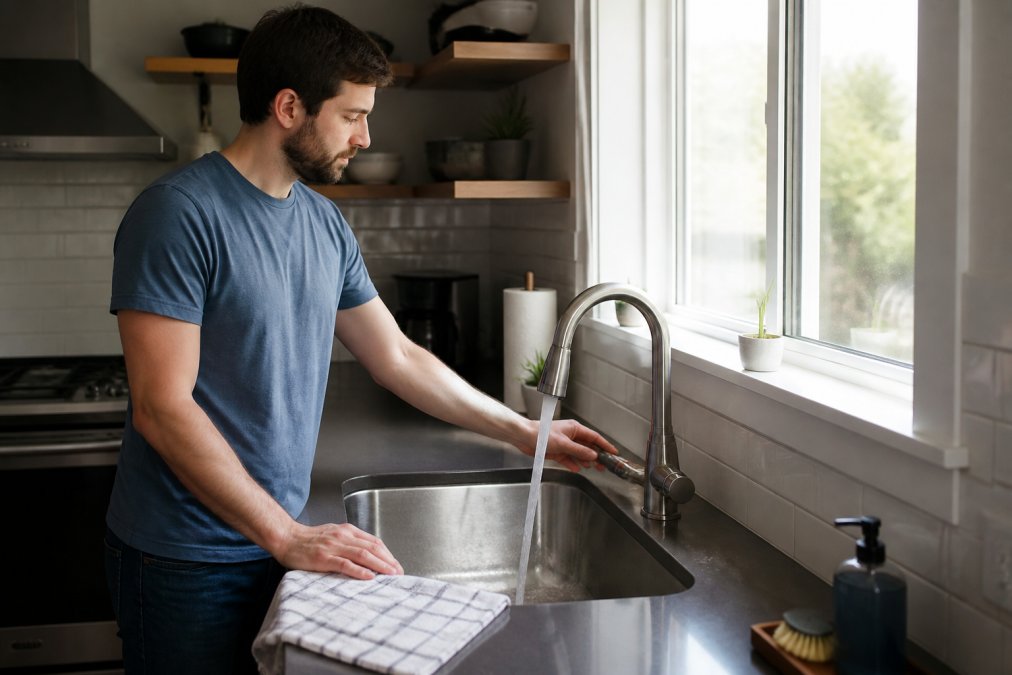
Here is the process:
- Run the cold water at the fixture with the worst taste for 2-3 minutes. Never flush with hot water, which draws more metal from your water heater.
- Open every cold tap in the house one at a time, letting each run for 2 minutes to push stagnant water through.
- Flush the toilet twice to clear that branch of the system.
- Remove and clean the faucet aerator. Unscrew it, soak it in white vinegar for 30 minutes, rinse, and reinstall.
- Retest the taste after flushing. If the metallic flavor returns within a few hours, the cause is ongoing corrosion or dissolved metals, not stagnation.
Identifying Your Pipe Material
Pipe material tells you how likely corrosion is and what to expect. Look at exposed pipes in your basement, crawl space, or under sinks.
- Galvanized steel: Dull gray, often with visible rust. High corrosion risk and a common source of metallic taste in older homes.
- Copper: Reddish-brown. Generally durable, but low pH water can still leach copper over time.
- PEX or CPVC: Plastic, usually white, blue, or red. These do not leach metal, so a metallic taste points elsewhere.
- Lead: Dull gray, soft enough to scratch with a key. If you find lead, stop and call a professional immediately.
A common mistake is assuming all older pipes are the problem. A single corroded section can contaminate the whole line, so identify the material before replacing anything.
Best Water Filtration Systems for Metallic Taste
The right system depends on your test results, not brand marketing. Match the technology to the contaminant and you solve the problem; guess and you buy twice. Here is how each option works, what it removes, and where it falls short.
Activated carbon filters work by adsorption: water passes through carbon granules or a block, and dissolved compounds, chlorine, chloramine, many taste-and-odor molecules, some organic metallic-flavor compounds, stick to the carbon’s huge internal surface area. Carbon is affordable and easy to maintain, but it does not remove dissolved iron, manganese, or hardness minerals well, and will not reliably remove lead unless specifically certified for lead reduction. A standard carbon pitcher or faucet filter is a taste fix, not a metal fix (nsf.org).
Reverse osmosis (RO) forces water through a semi-permeable membrane under pressure, rejecting dissolved metals, iron, manganese, copper, lead, along with most total dissolved solids. RO is the most thorough single-fixture drinking water option, the standard recommendation when a lab result shows a metal above a health-based limit. Trade-offs are real: RO wastes water as reject brine, strips beneficial minerals, needs pre-filters and a membrane replaced on schedule, and treats only the water passing through it, nothing for the shower or rest of the house.
Water softeners use ion exchange: calcium and magnesium swap places with sodium or potassium on a resin bed, eliminating the scale that traps and slowly releases metals inside pipes. A softener does not remove iron in meaningful amounts unless rated for iron, and does not remove lead. Look for on-demand regeneration based on actual water use rather than a fixed timer; it cuts salt and water waste substantially.
Iron-specific and oxidizing filters are the targeted answer when dissolved iron or manganese is confirmed. They use oxidation and filtration media to convert dissolved iron into trappable particles, the correct choice when iron is high enough that a softener alone would foul. They cost more up front and need periodic media replacement.
Whole-home filtration treats water where it enters the house so every fixture benefits. It is right when corrosion, not a single tap, is the problem, but it is the most expensive path and the one most often sold to homeowners who only needed a point-of-use fix.
For most households dealing with both metallic taste and hard water, the practical answer is a two-part setup: a softener or iron filter for the whole home and reverse osmosis at the kitchen tap. Test first, then size the system to the result.
Maintenance of Filtration Systems
Filtration only works if maintained, the part most guides skip. A saturated filter does not just stop removing metals; it can become a taste problem itself. Spent carbon harbors biofilm, and a loaded RO membrane lets contaminants pass while still producing clear water. If your water tasted fine after a filter change then turned metallic months later, a saturated cartridge is a likely culprit.
- Replace carbon cartridges on the manufacturer’s schedule, not when you remember. A filter past its rated capacity is worse than no filter for taste.
- Change RO pre-filters and membranes on time. A clogged pre-filter shortens membrane life, and a fouled membrane stops rejecting metals.
- Sanitize or replace housings and lines during cartridge changes to prevent biofilm that produces off-flavors.
- Keep the softener supplied with salt and check the brine tank for bridging, which stops regeneration and lets hardness return.
- Retest after every filter change and after any plumbing work or change in your supply.
The single most important maintenance habit is retesting after every filter change. It confirms the system is actually removing what you paid it to remove, and it catches the saturation problem before it reaches your glass.
When to Call a Professional Plumber
Call a professional when the cause is your plumbing, not your water. Flushing and filtration treat symptoms; they do not repair a failing pipe.
Specific situations that warrant a call:
- You find lead pipes or lead solder anywhere in the system.
- Rusty water appears after flushing and does not clear.
- The metallic taste returns within hours of flushing at every fixture.
- You notice leaks, low pressure, or visible corrosion on exposed pipes.
- Your water quality report flags a contaminant you cannot treat at the fixture.
A plumber can assess pipe integrity, identify the failing section, and advise whether repair or replacement makes sense. This is also the moment to bring in a water treatment specialist, since pipe repair and water treatment solve different halves of the same problem.
Where we see homeowners waste the most money is replacing pipes when the real issue was water chemistry attacking otherwise sound plumbing. Fix the water and the corrosion slows.
Health Risks: Is It Safe to Drink Water That Tastes Like Metal?
Metallic taste falls into two very different categories, and taste alone cannot tell you which one you have. The useful skill is sorting nuisance causes from hazard causes before deciding whether to relax or act.
Nuisance metals are the common ones: iron and manganese. At typical household levels they affect taste, color, and staining but are not linked to acute illness. If your water tastes like a coin, leaves rust or black stains, and your utility report shows iron or manganese within secondary (aesthetic) limits, it is most likely a nuisance problem, unpleasant, not dangerous.
Hazard metals are the ones that matter: lead and, at high enough concentrations, copper. These do not announce themselves with a strong taste. Lead has no safe level in drinking water and typically enters not from the source but from lead service lines, lead solder in older plumbing, or brass fixtures and fittings (the CDC). Copper becomes a health concern at elevated concentrations and can cause gastrointestinal symptoms. The critical point: a metallic taste from corrosion can travel alongside lead you cannot taste, which is why testing, not your palate, is the deciding factor.
A practical way to triage:
- One fixture, intermittent taste: likely an aerator or a rarely used branch. Low concern.
- Taste after the water sits overnight, clears after flushing: points to corrosion in your own plumbing. Test for lead and copper.
- Blue-green staining on fixtures or pinhole leaks in copper pipe: active copper corrosion. Test and address.
- Taste plus a utility report or lab result showing lead above the action level: stop drinking the water and treat it as a priority.
If your home was built before lead solder was banned in the 1980s, or you have a lead service line, treat any corrosion signal as a reason to test rather than wait (the EPA). Many utilities publish service line material maps, and a certified lab test is the only way to know what is actually in your glass.
If a result shows lead, bacteria, or other contaminants above safe limits, stop drinking the water and address it immediately, do not rely on flushing or a pitcher filter unless it is specifically certified for that contaminant. For households that simply want certainty, a reverse osmosis drinking water system removes the metals and dissolved solids that cause the taste and provides a reliable barrier against the contaminants you cannot see or taste.
Metallic taste plus any of these signs means test immediately: blue-green staining on fixtures, pinhole leaks in copper pipe, a home built before the mid-1980s, or a recent change in how your water tastes. Each points to active corrosion releasing metals into your supply.
Frequently Asked Questions
Why is my tap water tasting metallic?
A metallic taste usually comes from dissolved iron, copper, or zinc leaching into your water supply. The most common culprits are corroded galvanized pipes, copper plumbing reacting to acidic water, or a water heater with a failing anode rod. If the taste is stronger in hot water, the water heater is likely the source. If it shows up only in the morning or after vacation, stagnant water sitting in your pipes is picking up metal particles overnight. A water quality report from your utility can rule out source-water issues before you investigate your home’s plumbing.
Is it safe to drink water that tastes like metal?
In most cases, a metallic taste at low levels is not immediately dangerous. However, it can signal corrosion in your plumbing system, which means other contaminants like lead or copper could also be present. The EPA sets maximum contaminant levels for copper at 1.3 mg/L and iron at 0.3 mg/L as secondary standards. If your water has a strong metallic flavor, rusty color, or you have older galvanized pipes, test your water before continuing to drink it. Children and pregnant women should be especially cautious with unexplained metallic tastes.
What neutralizes metallic taste in drinking water?
You can reduce metallic taste at home by flushing stagnant water from your pipes for 2-3 minutes before drinking, cleaning your faucet aerator to remove trapped sediment, and using an activated carbon filter or reverse osmosis system. A water softener helps if hardness is causing pipe corrosion. For a lasting fix, address the source: replace corroded pipe sections, install a whole-home filtration system, or add a point-of-use reverse osmosis unit under your kitchen sink. Testing your water first ensures you target the right cause instead of guessing.
Can old plumbing cause a metallic taste in tap water?
Yes, old plumbing is one of the most common causes. Galvanized steel pipes, common in homes built before the 1960s, corrode over time and release iron and zinc into your water. Copper pipes can also leach copper if your water is acidic or has high total dissolved solids. If your home has older pipes and you notice the metallic taste is worse in the morning or after the water has been sitting, your plumbing is likely the source. A plumber can inspect pipe condition and recommend replacement or a filtration solution.