

Table of Contents
- How Much Extra Soap Does Hard Water Waste?
- The Chemistry Behind Hard Water Waste Soap
- Do I Need to Use More Detergent if I Have Hard Water?
- How to Test for Hard Water at Home
- Does a Water Softener Save Money?
- Other Costs of Hard Water You Might Be Ignoring
- Conclusion
- Frequently Asked Questions
Last Updated: September 6, 2026
How Much Extra Soap Does Hard Water Waste?
Hard water waste is a silent drain on household budgets, forcing families to pour extra detergent, soap, and cleaning products down the drain just to get the same results. Homes with hard water can easily use double the soap compared to homes with soft water for bathing, laundry, and dishwashing.
The issue isn’t your soap, your washing machine, or your habits. It’s the water itself. When hard water meets soap, a chemical reaction prevents lather from forming properly, meaning you must keep adding more product to feel clean.
The Chemistry Behind Hard Water Waste Soap
Hard water is water that contains high concentrations of dissolved minerals, primarily calcium ions and magnesium ions. These minerals are picked up as groundwater passes through limestone, chalk, and gypsum deposits, which are abundant across Kansas and Oklahoma.
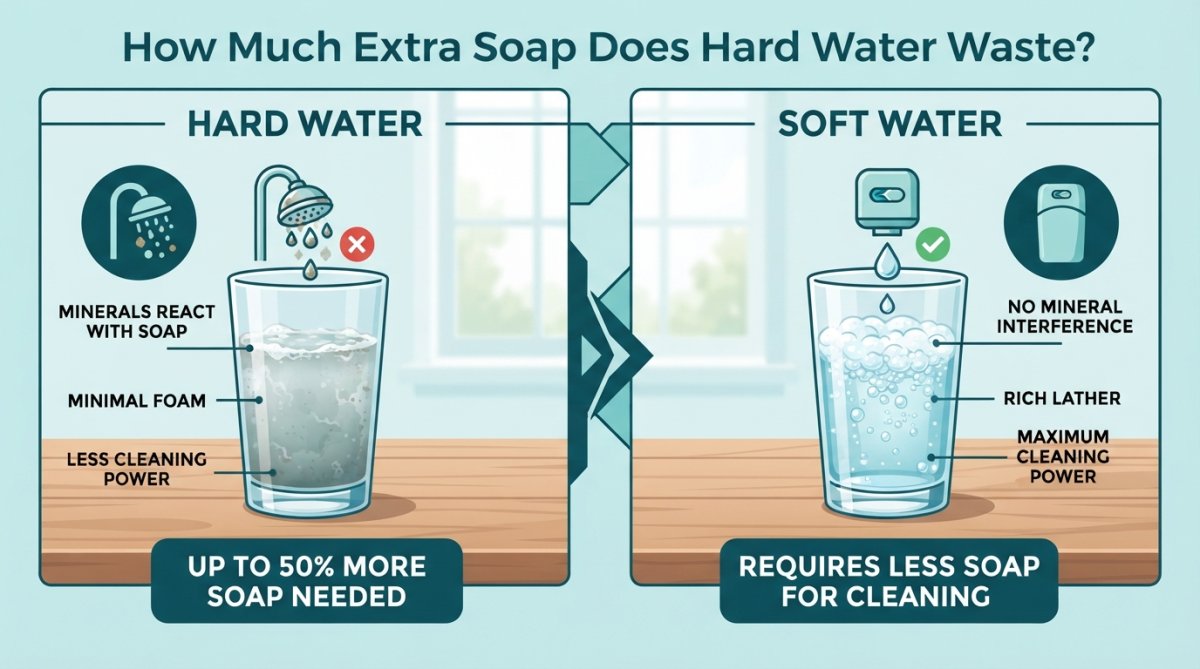
When you mix soap with hard water, the calcium and magnesium ions react with the fatty acids in the soap, specifically sodium stearate, forming an insoluble precipitate: the gray, sticky film you recognize as soap scum. Because the soap molecules bind to the minerals instead of your skin or dishes, they never get a chance to do their actual cleaning work.
Surfactants are the active cleaning agents in soap that surround dirt and oil to lift them away. In soft water, surfactants form micelles that trap grime and rinse away easily. In hard water, those same surfactants are neutralized by the minerals before they can form micelles, so the soap is wasted before cleaning even begins.
This explains why the water hardness level directly controls your soap consumption. Water hardness is measured in grains per gallon (gpg). Water above 7 grains per gallon is considered hard, and at 10 to 15 grains per gallon, which is common in parts of Kansas and Oklahoma, the soap-wasting effect becomes dramatic.
The most common mistake homeowners make is simply adding more detergent to compensate for hard water. This does produce more lather, but it also leaves behind more soap scum, mineral deposits, and residue on your skin, hair, and clothing. The extra soap doesn’t solve the problem; it amplifies the side effects.
Do I Need to Use More Detergent if I Have Hard Water?
The short answer is yes, but that’s the wrong fix. Many households use 50 to 100 percent more laundry detergent, dish soap, body wash, and shampoo when their water is hard.
Excess soap residue gets trapped in fabric fibers, making clothes feel stiff and look dingy. It builds up on skin and hair, leading to dryness and irritation, and coats shower doors and tiles with a film that attracts more buildup over time.
Detergents, synthetic cleaning agents, handle hard water better than traditional bar soap because they contain chelating agents that bind to calcium and magnesium ions. However, even modern detergents lose effectiveness as water hardness increases, which is why manufacturers include dosage charts instructing you to add more product for hard water.
The practical answer is not to keep increasing your detergent usage. The fix is to remove the minerals from the water before they meet your soap. That’s what a home water softening system does.
Quantifying the Waste: A Cost-Per-Year Perspective
To move beyond generalities, consider a typical household with water hardness at 10 grains per gallon (gpg).
- Laundry Detergent: A standard high-efficiency (HE) washer uses about 2 ounces of liquid detergent per load. With hard water, you might need to increase this by 50%, or 3 ounces per load. If you run 8 loads per week, that’s an extra 8 ounces of detergent weekly, or 416 ounces (about 3.25 gallons) annually. At an average cost of $0.50 per ounce for premium liquid detergent, that’s an extra $208 per year just for laundry.
- Dishwasher Detergent: Automatic dishwasher detergent is also affected. A standard pod or gel pack is designed for soft water. In hard water, you may need to add a rinse aid and use a more robust detergent. The extra cost for a specialized hard-water detergent and increased rinse aid can add up to $50 to $100 per year.
- Body Wash and Shampoo: The extra product needed to create a satisfying lather in the shower is significant. If you use 50% more body wash and shampoo, a family of four could easily spend an additional $150 to $250 per year on these personal care products.
These figures are not exact for every home, but they illustrate a clear pattern: the cumulative cost can easily reach $400 to $600 per year or more.
A Unique Angle: Surfactant Chemistry as a Workaround
While a whole-home softener is the definitive fix, a class of cleaning agents performs better in hard water without requiring a major installation: non-ionic surfactants and specific chelating builders formulated to be more tolerant of mineral ions.
Most traditional soaps are anionic surfactants, which carry a negative charge that hard water minerals readily bind to, creating soap scum and neutralizing their cleaning power. In contrast, non-ionic surfactants have no electrical charge, making them less reactive with hard water minerals while still effectively lifting oils and dirt.
Look for products listing ingredients like alcohol ethoxylates or alkyl polyglucosides (non-ionic surfactants) or containing citric acid or EDTA (chelating agents). These can reduce the amount of product you need without the expense of a softener. However, this is a product-by-product workaround, not a complete solution.
| Water Hardness | Typical Soap Waste | Recommended Approach |
|---|---|---|
| Soft (0-3 gpg) | Minimal | Standard detergent dosage |
| Moderately Hard (3-7 gpg) | 25-50% more soap needed | Increase dosage or consider softening |
| Hard (7-10 gpg) | 50-75% more soap needed | Softening recommended |
| Very Hard (10+ gpg) | Up to 100% more soap needed | Water softener strongly advised |
If you’re currently using more detergent than the manufacturer recommends and still seeing spots on dishes or feeling a film on your skin, that’s a strong signal your water hardness is above 7 grains per gallon. Stop adding more soap and test your water first.
How to Test for Hard Water at Home
Testing your water hardness at home takes about five minutes and requires no special equipment. The most reliable method is a home test kit that uses a color-changing strip, available at most hardware stores and online retailers.
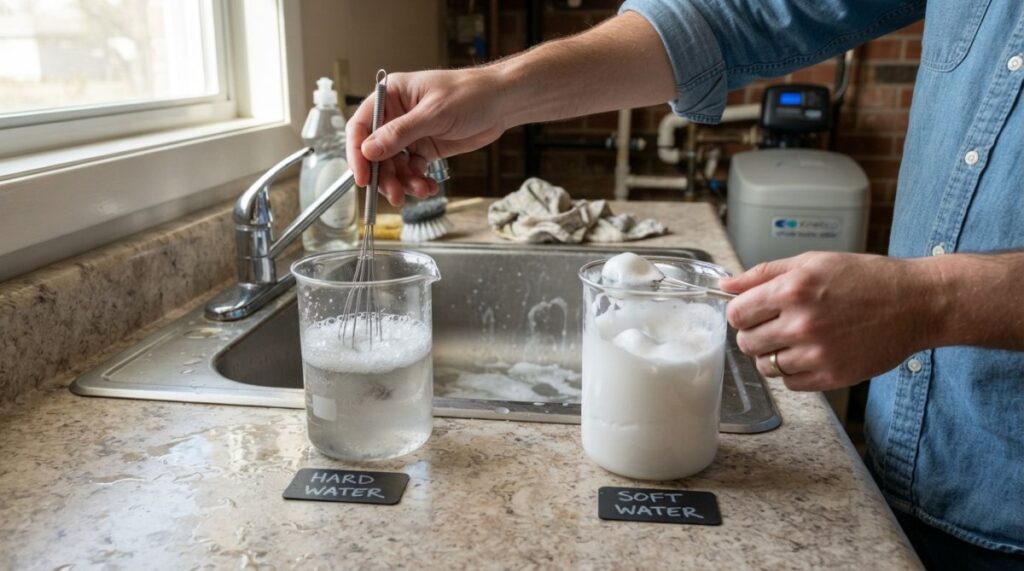
A quick preliminary check: fill a clear glass bottle one-third full with tap water, add a few drops of liquid dish soap, and shake vigorously. Thick, fluffy bubbles on top indicate soft water; cloudy water with a thin layer of suds that dissipate quickly indicates hard water.
For a more precise reading, collect a water sample in a clean container and use a test strip that measures total hardness. Dip the strip, wait the specified time, and compare the color change to the chart on the package.
The United States Geological Survey provides detailed information on water hardness classifications and what the measurements mean explains that hardness is typically reported as milligrams per liter of calcium carbonate, and you can convert that number to grains per gallon by dividing by 17.1. If your test shows results above 7 grains per gallon, you have hard water, and the soap-wasting effects described earlier are affecting your home.
A simple soap-and-water shake test tells you if you have hard water, but only a measured test in grains per gallon tells you how severe the problem is. That number determines how much soap you’re wasting and whether a softener makes financial sense.
Does a Water Softener Save Money?
A water softening system saves money in several ways, and the savings on soap and detergent alone often cover a meaningful portion of the system’s cost. Ion exchange softeners replace calcium and magnesium ions with sodium ions, removing the minerals that cause soap waste before the water reaches your faucets.
When you soften your water, you immediately reduce soap and detergent usage across every cleaning task. Laundry requires less detergent, dishwashers need less rinse aid, and showers produce rich lather with a normal amount of body wash or shampoo.
Beyond soap savings, soft water protects your appliances and plumbing. Hard water causes scale buildup inside water heaters, washing machines, and dishwashers, forcing them to work harder and fail sooner. Research from the Water Quality Association on the effects of hard water on appliance efficiency and lifespan has documented that scale buildup reduces water heater efficiency and shortens the service life of major appliances. Replacing a water heater or washing machine years earlier than necessary is a much larger expense than the cost of softening your water.
A Realistic Payback Period Analysis
The exact payback period depends on your water hardness, household size, and current soap usage. For most families with hard water above 8 grains per gallon, reduced soap purchases, lower energy bills, and fewer repairs make a water softener a sound investment.
Consider a typical scenario: a family of four in a home with 10 gpg water might spend an extra $500 per year on soap, detergent, and personal care products. They might also face a water heater replacement 3-5 years earlier than expected, costing $1,200 to $1,800. The annual energy penalty from scale buildup on a water heater is estimated by the U.S. Department of Energy to be up to 8%, adding $50 to $100 to annual energy bills.
A quality ion-exchange softener for a typical home, including installation, can range from $1,500 to $3,000. Annual maintenance, including salt for regeneration, is typically $100 to $200.
- Annual Savings from Soft Water: $500 (soap) + $75 (energy) = $575 per year.
- Annual Cost of Softener Ownership: $150 (salt) + $150 (amortized maintenance/repairs) = $300 per year.
- Net Annual Savings: $575 – $300 = $275 per year.
In this model, the softener pays for itself in approximately 5 to 7 years through operational savings alone, not including the avoided cost of premature appliance replacement.
The Environmental Angle: Beyond Your Wallet
The waste from hard water isn’t just a financial issue; it has an environmental footprint. The extra soap, detergent, and cleaning chemicals required to combat hard water end up in the wastewater stream, introducing more synthetic surfactants, phosphates, and other compounds into the environment.
By softening your water, you reduce your household’s chemical load and energy demand, making a water softener a more sustainable choice.
When you total the extra soap, detergent, cleaning products, skin care, appliance repairs, energy bills, and premature replacement of clothes and appliances, hard water costs most families far more than a water softening system costs to install and maintain. A realistic payback period is often 5-7 years, after which the savings continue to accrue.
Other Costs of Hard Water You Might Be Ignoring
The soap waste is the most visible cost of hard water, but it’s not the only one. Hard water creates a ripple effect of expenses many homeowners don’t connect to their water quality.
Laundry performance suffers noticeably. Hard water minerals bind to fabric fibers, making whites look gray and colors fade faster. Clothes wear out sooner because the mineral residue acts like fine sandpaper during washing and drying.
Skin irritation is another hidden cost. The soap scum residue left on your skin after showering in hard water strips away natural oils, leading to dryness, itching, and flare-ups of conditions like eczema.
Rinsing efficiency drops with hard water. The mineral film left on dishes, glasses, and shower doors requires extra rinsing, extra scrubbing, and specialty cleaning products to remove.
Scale buildup in pipes is perhaps the most expensive hidden cost. Over time, hard water minerals accumulate inside your plumbing, narrowing the pipes and reducing water pressure throughout your home. Information from the U.S. Department of Energy on how mineral scale affects water heater efficiency and energy consumption notes that even a thin layer of scale on heating elements forces the system to use more energy to heat the same amount of water, which shows up directly on your utility bill.
When you total the extra soap, detergent, cleaning products, skin care, appliance repairs, energy bills, and premature replacement of clothes and appliances, hard water costs most families far more than a water softening system costs to install and maintain.
Conclusion
The amount of soap that hard water wastes is not a minor inconvenience; it’s a measurable financial drain that touches nearly every cleaning task in your home. From the chemistry that neutralizes your soap to the extra detergent you’re forced to buy, hard water quietly increases your household expenses while damaging your appliances, clothing, and skin.
At Dooley’s Water, we’re a family-owned company established in 2003 and an authorized Kinetico dealer serving Kansas and Oklahoma. Our Kinetico water softeners, drinking water systems, and whole-home filtration solutions are tailored to your specific water quality needs, and our team provides comprehensive support and swift servicing after installation. We start every project with a free water analysis.
Frequently Asked Questions
Do I need to use more detergent if I have hard water?
Yes. Hard water contains calcium and magnesium ions that react with soap to form an insoluble precipitate, or soap scum. This reaction happens before the soap can create a lather, so you must add more detergent to get the cleaning action you need. In areas with very hard water, you might use double the recommended amount of laundry detergent to achieve the same results as someone with soft water.
How does hard water affect the lathering process of soap?
The calcium and magnesium ions in hard water react with the fatty acids in soap to form soap scum instead of lather. This chemical reaction prevents the soap from creating the bubbles needed to lift dirt and grease. As a result, you need to use significantly more soap to build a sufficient lather for cleaning your skin, hair, dishes, or laundry.
What is the best soap to use if you have hard water?
Synthetic detergents are generally more effective than traditional soaps in hard water. Detergents use surfactants that do not react with calcium and magnesium ions the same way soap does, so they are less likely to form soap scum. However, even with detergents, you will likely still need to use more product than recommended to compensate for the reduced lather and rinsing efficiency caused by hard water minerals.
Can a water softener reduce soap waste?
Yes, installing a water softener eliminates the calcium and magnesium ions that cause soap waste. With soft water, soap and detergent can lather immediately and work at full strength. Most homeowners find they can reduce their soap and detergent usage by 50% or more after installing a water softening system, which directly translates to significant cost savings over time.
Get started with Dooley’s Water and schedule your free water analysis today to see how much you can save on soap, detergent, and appliance repairs.